
Shoppers have stopped searching for “floral” and “woody”. They search for the note: pistachio, matcha, caramel, honey. According to Spate data reported by Forbes in October 2026, those four are among the fastest-growing fragrance notes this year, alongside vanilla and oud. Here is what each one smells like, what perfumers reach for to build it, and how to try it in your own formulas.
Why specific notes are replacing families
A family tells you very little. “Gourmand” can mean a sugar cookie or a roasted coffee bean. A note tells you what you will smell. Spate’s data, as reported by Forbes, points to TikTok driving discovery and Google capturing purchase intent: people see a note on social media, then search for it by name.
For perfume makers this is useful. A note is a brief you can act on. You can look up the materials behind it, build a small accord, and test it.
The four notes of 2026
Pistachio
Pistachio reads creamy, nutty and a little green. Euromonitor’s Aishwarya Rajpara told Forbes that brands are pairing creamy gourmand notes with pistachio, black tea, smoky woods and roasted-grain accords.
A pistachio note is almost always an accord, not a single material. Perfumers commonly describe it as a nutty, creamy impression on a soft woody or tonka base, with a green edge. Explore nutty and creamy materials in Xhelf and check the descriptors Nuts and Milk.
Matcha and green tea
Matcha is leafy, bright and slightly bitter. Natural tea extracts are expensive, so perfumers usually build the tea note from other materials, as Tonya Kidd-Beggs of STORIES Parfums told Forbes.
That makes matcha a good first project. Start from a green, leafy top note and add a soft, milky or woody base so it stays smooth. Look at cis-3-hexenol for the cut-grass and leaf character, and compare it with a tea absolute.

Caramel
Caramel is warm, toasted sugar. In perfumery it is usually suggested with sweet, burnt-sugar materials rather than anything that smells like the real thing. Furaneol, maltol and ethyl maltol are the ones perfumers often compare first, and they are strong, so small amounts go a long way.
Caramel works best with something to hold it up. Pair it with tonka or vanilla so it reads as warmth and not as candy.
Honey
Honey is sweet, waxy and golden. Hay, beeswax and balsamic materials all sit near it. Beeswax and hay are classic materials in honey accords, and honey is a good reason to learn how a small amount of a strong material changes a whole blend.
Try it with a little hay or beeswax absolute and a soft amber base, then smell it again after an hour to see how it settles.
Gourmands are growing up
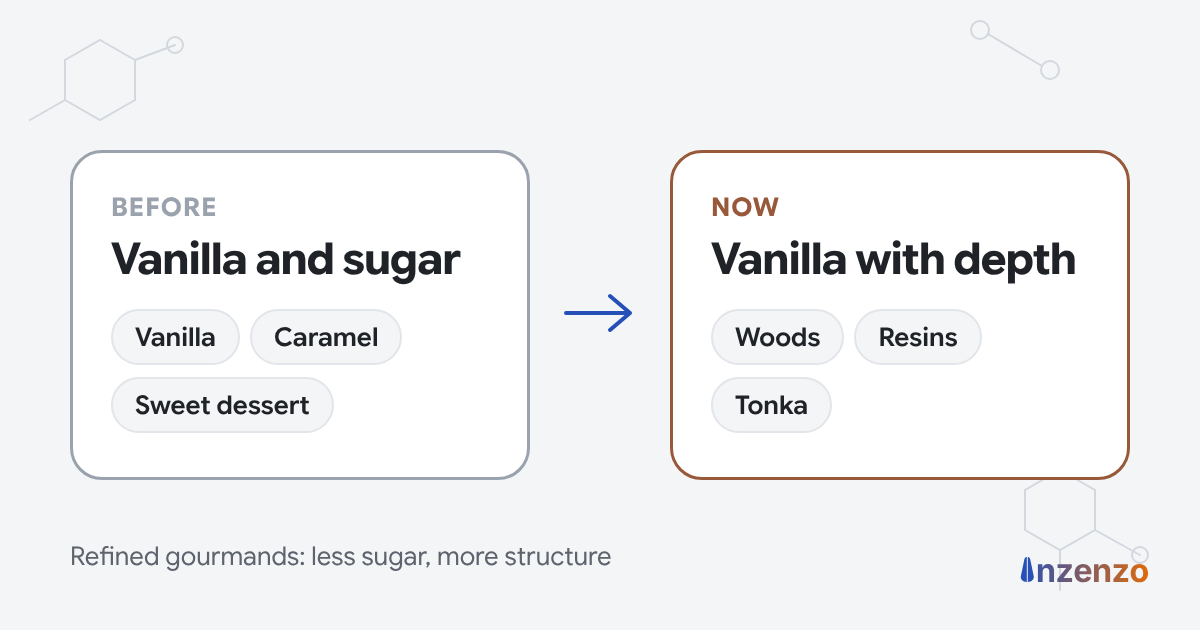
Sweetness is not going away, but the sugar is. Jonny Webber of PerfumeDirect.com told Forbes that gourmands “aren’t disappearing; they are simply growing up”. He said perfumers are adding coffee, salt, smoke, leather, woods, tea, spice and savoury notes to interrupt the sweetness. In Beauty Independent’s survey, founders also expected refined gourmands, with vanilla paired with woods, resins or tonka rather than heavy sugar.
If you make gourmands, the lesson is structure. Keep the sweet note, then give it a dry, woody or resinous partner so it does not fall flat on skin.
Three smaller trends worth knowing
- Scent stacking. Layering two or more fragrances is becoming a way to express identity, not just a styling trick, according to Cosmetics Business.
- Slow perfumery. A counter-trend to fast launches that favours maturing and macerating, and more complex, long-lasting perfumes with a story.
- Alcohol-free formats. Cosmetics Business lists alcohol-free fragrances as its first trend of 2026.
Try a trending note yourself
- Open the Formula maker and start a new formula.
- Add one or two materials from the note you want, and a base that matches it.
- Choose your IFRA category and read the limit next to each material. Some sweet and spicy materials have limits, so check before you smell it on skin. The IFRA tools show each limit.
- Save it, wait a day, and smell it again. Write down what changed.
Keep each test small. A strong material like those used for caramel and honey can take over a blend at one percent.
Frequently asked questions
What notes are trending in perfume in 2026?
Spate data reported by Forbes lists pistachio, caramel, honey and matcha among the fastest-growing fragrance notes, alongside vanilla and oud. Refined gourmands, tea and coffee notes are also rising.
What does pistachio smell like in perfume?
Creamy, nutty and slightly green. It is usually an accord built from nutty, creamy and woody materials, not a single ingredient.
Is a gourmand perfume always sweet?
No. Many 2026 gourmands add coffee, tea, smoke, woods or spice to cut the sweetness and sit closer to the skin.
Can I make a trending note at home safely?
Yes, with care. Keep batches small, check the IFRA limit for each material and your product category, and test on a smelling strip before skin. This is guidance, not an IFRA certificate or safety advice.
Sources
- Forbes, “Fall 2026 fragrance trends: gourmands are growing up”, Laia Farran Graves, 16 October 2026 (updated 26 October 2026)
- Cosmetics Business, “Cosmetics Business reveals the top 5 fragrance trends of 2026 in new report”, 11 May 2026
- Beauty Independent, “What’s next for fragrance in 2026, and what’s fading out”