“Natural or synthetic?” is the first question most people ask about a perfume, and it is the wrong one. A perfumer asks a different question about every material: what is it made of, how much of it is in the formula, and does it have a safety limit? Origin alone answers none of those. Natural materials can be restricted or banned. Synthetic materials can be among the best-studied and least restricted in the palette.
What counts as natural in perfumery
In the industry, “natural” has a narrow meaning. The fragrance industry’s own definition follows ISO 9235: a natural aromatic raw material comes from a plant, animal or microbiological source and is obtained by physical, enzymatic or microbiological processes, such as distillation, expression or extraction. A synthetic material is made by chemical reaction.
That definition is about how a material is obtained, not how it behaves. It says nothing about safety, strength or sustainability. IFRA, the fragrance industry association, has said for years that neither natural nor synthetic can be claimed as the more sustainable choice by default.
The four kinds of perfume ingredient
Most arguments about natural versus synthetic treat all materials as two boxes. Perfumers work with four.
| Kind | What it is | Examples |
|---|---|---|
| Natural complex | A whole extract with hundreds of components | Bergamot oil, rose absolute, vetiver oil, oakmoss absolute |
| Natural isolate | One component separated from a natural source | Linalool from a natural oil, limonene from orange oil |
| Nature-identical synthetic | Made by chemistry, with the same molecule found in nature | Synthetic vanillin, synthetic linalool |
| Novel synthetic | A molecule not known as a natural material | Iso E Super, many musks |
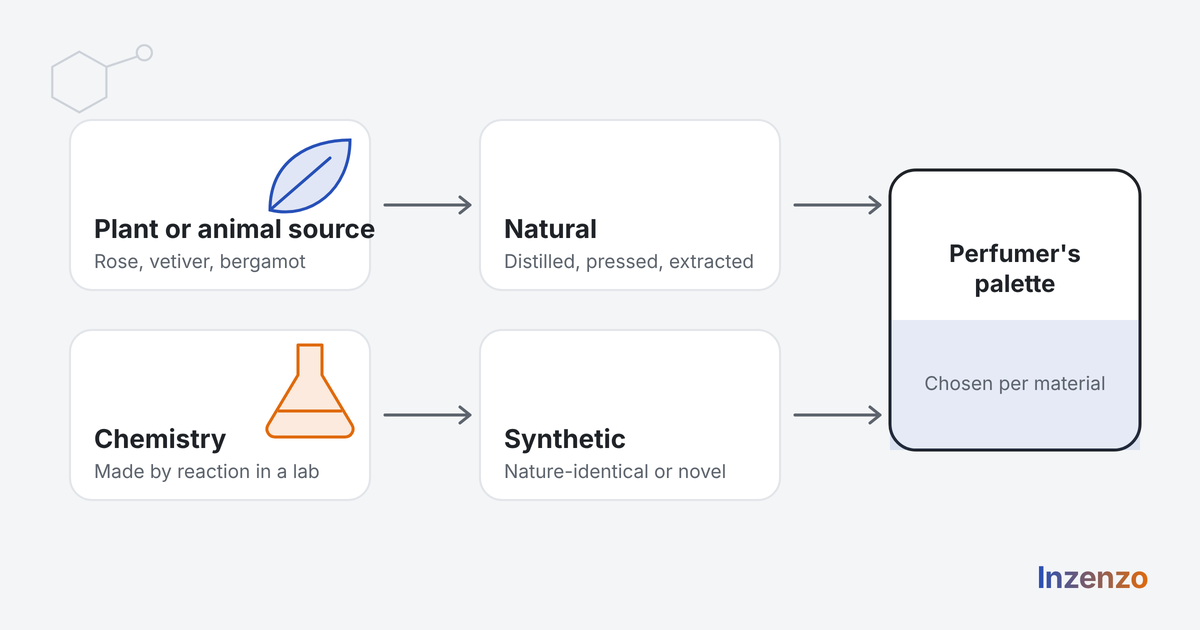
Two things follow from this table. First, a natural complex is a mixture, so its behaviour depends on every component in it, including ones you did not choose. Second, a nature-identical synthetic and its natural isolate are the same molecule. Your skin and your nose cannot tell which factory it came from.
Why perfumers use synthetic ingredients
Synthetics are not a shortcut. They are how many of the scents people love exist at all.
- They make notes that cannot be extracted. Lily of the valley, lilac and fresh linen give no usable oil. Their scents are built.
- They stay consistent. A harvest changes with weather and soil. A synthetic is the same in every batch, so the 5,000th bottle smells like the first.
- They protect species and land. Some natural sources are scarce, expensive or ethically difficult. Synthetic musks and ambergris-type materials replaced animal sources.
- They are better studied for some endpoints. A single molecule can be tested and assessed on its own. A natural oil has to be assessed as the mixture it is.
- They carry strength and longevity. Many synthetic musks, woods and ambers are slow to evaporate and powerful in small amounts, which is why they sit in the base of so many formulas.
Why perfumers still use natural ingredients
Naturals bring something a single molecule rarely does: complexity. Rose oil holds hundreds of components that lift, round and add depth together. A good natural also changes as it dries down, which gives a formula life.
Perfumers also use naturals for their character, for the story and craft behind them, and because some effects are hard to rebuild. Most fine fragrances use both, because each solves a different problem.
Longevity is the material, not the origin
Whether a perfume lasts has nothing to do with whether it is natural. It depends on how slowly each material evaporates. Vetiver, patchouli, sandalwood, benzoin and labdanum are natural and stay for hours. Citrus oils are natural and leave within the hour. Synthetic musks stay, and some synthetic fresh notes leave quickly.
This is the same point made in eau de parfum vs eau de toilette: a formula lasts as long as its slowest materials allow. Choosing natural or synthetic does not change that. Choosing slow materials does.
Myth: synthetic means harmful, natural means safe
This is the most common belief about perfume ingredients, and the safety rules themselves show it is wrong. The International Fragrance Association (IFRA) sets Standards for fragrance materials. They come in three types: prohibition, restriction and specification. They are based on assessments by the Research Institute for Fragrance Materials (RIFM) and reviewed by an independent expert panel. As of the 51st Amendment (notified 30 June 2023), there are 263 IFRA Standards in total.
The Standards do not sort materials by origin. They sort them by what a material does: cause skin allergy, react with sunlight, harm the environment or affect reproduction. Both natural and synthetic materials appear on the list. Both appear off it.
Examples of restricted or banned materials, natural and synthetic
| Material | Origin | Rule | Reason |
|---|---|---|---|
| Costus root oil, absolute and concrete | Natural | Prohibited, IFRA STD 124 (2006) | Skin sensitisation |
| Oakmoss extracts | Natural | Restricted, IFRA STD 067: 0.1% in fine fragrance (Category 4), lower in other categories | Skin sensitisation, mainly from atranol and chloroatranol |
| Bergamot oil, expressed | Natural | Restricted, IFRA STD 087: 0.40% in Category 4 | Phototoxicity (reaction with sunlight). The furocoumarin-free grade avoids it |
| Tagetes oil and absolute | Natural | Restricted by IFRA for phototoxicity. The EU scientific committee set 0.01% for leave-on products | Phototoxicity |
| Musk xylene | Synthetic | Prohibited, IFRA STD 170 (2009) | Environment: very persistent and bioaccumulative |
| Lyral (HICC) | Synthetic | Not allowed on the EU market from 23 August 2021 under Regulation 2017/1410 | Strong skin sensitiser |
| Lilial (BMHCA) | Synthetic | Banned in EU cosmetics from 1 March 2022 | Reproductive toxicity |
| Musk ketone | Synthetic | IFRA specification: must contain under 0.1% musk xylene | Impurity control |
Look at the “Origin” column. Three of the strictest rules, on costus, oakmoss and tagetes, fall on natural materials. Oakmoss is a classic natural: untreated oakmoss absolute can hold roughly 2 to 3% atranol and about 1% chloroatranol, which is why the standard caps both in the extract at 100 ppm each. The EU also prohibits atranol and chloroatranol, with trace amounts tolerated.
Examples with no or low concern
| Material | Origin | Status |
|---|---|---|
| Hedione (methyl dihydrojasmonate) | Synthetic | Supplier IFRA certificates list “no restriction” in all categories. The RIFM assessment found it safe under the limits it describes, not phototoxic, and not persistent or bioaccumulative |
| Vetiver oil, Haiti | Natural | Supplier listings show “no restriction” for fine fragrance (Category 4) under the 51st Amendment. Some other categories carry limits because of trace constituents |
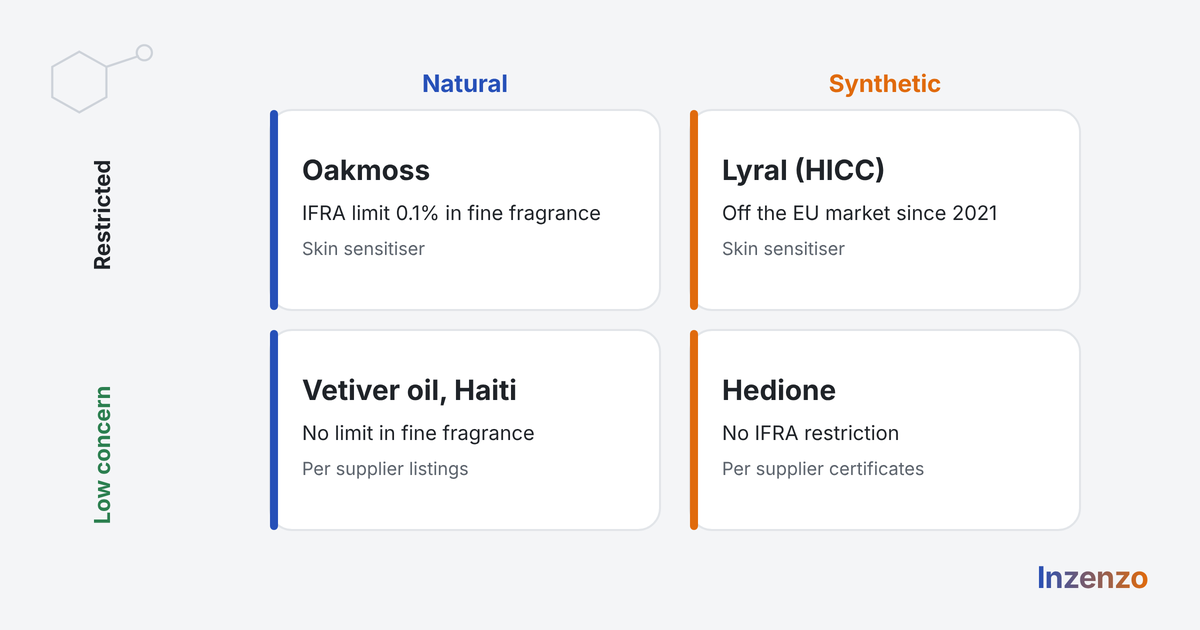
So the pattern is not “synthetic bad, natural good”. Some materials are restricted because they sensitise skin. Some react with light. Some damage the environment. Each has its own rule and its own cause.
What this means in practice
- A natural label does not make a material safe: costus oil is natural and prohibited.
- A synthetic label does not make a material unsafe: Hedione is synthetic and has no IFRA restriction in fine fragrance.
- The question to ask of any material is whether it has an IFRA Standard, which category you are formulating for, and what concentration your formula reaches.
- Limits depend on the product. The same material can be fine in a perfume and restricted in a lip balm.
Always check the current Standards before you rely on a limit. Amendments are published regularly, and a limit that applied last year may have moved.
Allergens in practice
Allergens are a separate question from origin. Many fragrance allergens, such as linalool, limonene and citral, are found in natural oils and are also made synthetically. They are the same molecules either way, so a “natural” perfume with a lot of lemon oil can carry the same labelled allergens as a synthetic lemon accord.
In the EU, fragrance allergens above set levels must be named on the label. Regulation (EU) 2023/1545 expanded the list. If you formulate for the EU, check the current list and the transition dates for your product type.
For a formulator the practical steps are short:
- Know the allergen content of every natural oil you use, because it varies by batch and source.
- Add up each allergen across the whole formula, not material by material.
- Compare each total with the label threshold and the IFRA limit for your product category.
Sustainability is not a simple win for either side
Natural does not automatically mean sustainable. A crop can take land, water and years to grow, and some wild sources have been over-harvested. Synthetic does not automatically mean sustainable either: a material made from petrochemicals can persist in the environment, which is exactly why musk xylene was banned.
Sustainability depends on the specific material: how it is grown or made, how much goes into the formula, and what happens after use. Some synthetics are made from renewable raw materials. Some naturals come from the waste of the food industry. Judge each material on its own record.
Other myths, quickly
| Myth | What is closer to the truth |
|---|---|
| Natural perfumes last longer | Longevity follows the material, not the origin |
| Natural perfumes cannot cause allergies | Many natural oils contain well-known sensitisers |
| All-natural perfume is not possible | It is possible, but it limits the palette, and certain notes cannot be made |
| Synthetics smell flat | Many are layered and radiant, and perfumers often choose them for exactly that |
Frequently asked questions
Are synthetic perfume ingredients bad for you?
No. Safety depends on the specific material and the concentration, not on where it comes from. IFRA and the EU restrict some synthetic ingredients, for example Lyral and Lilial, and also restrict natural ones, for example oakmoss and costus. Many synthetic materials, such as Hedione, have no IFRA restriction in fine fragrance.
Are natural ingredients always safer?
No. Natural ingredients are mixtures, and some of their components are potent sensitisers or react with sunlight. That is why oakmoss, tagetes and bergamot oil have limits and costus oil is prohibited by IFRA.
Which natural ingredients does IFRA restrict?
Examples include oakmoss extracts, expressed bergamot oil, tagetes oil and absolute, and citrus oils with furocoumarins. IFRA prohibits costus root oil, absolute and concrete. The full list is in the IFRA Standards library.
Which synthetic ingredients are banned or restricted?
Examples include musk xylene (prohibited by IFRA), Lyral (not allowed on the EU market from 23 August 2021) and Lilial (banned in EU cosmetics from 1 March 2022). Others are restricted by IFRA at set concentrations.
What is a nature-identical ingredient?
It is a material made by chemistry that has the same molecular structure as one found in nature, such as synthetic vanillin. It is the same molecule as the natural version, so it smells and behaves the same when the purity is the same.
Can you make a good perfume with only natural ingredients?
Yes, but the palette is narrower. Some notes, such as lily of the valley, have no usable extract, and a few base materials such as modern musks are hard to match with naturals. Many natural-only perfumes lean on citrus, florals, woods and resins, and they need careful attention to allergens and IFRA limits.
Sources
- IFRA Standards library and Standards Information: ifrafragrance.org
- IFRA 51st Amendment notification, 30 June 2023
- IFRA STD 067 (oakmoss), STD 087 (bergamot oil expressed), STD 124 (costus), STD 170 (musk xylene)
- Regulation (EU) 2017/1410 (Lyral, atranol and chloroatranol)
- Regulation (EU) 2021/1902 and its Lilial amendment, applying from 1 March 2022
- Regulation (EU) 2023/1545 (fragrance allergen labelling)
- ISO 9235, natural aromatic raw materials, vocabulary
- RIFM safety assessments, Hedione